Yestermorrow Design/Build School in Waitsfield, Vermont offers over 80 hands-on courses per year in design, construction, woodworking, and architectural craft and offers a variety of courses concentrating in sustainable design. Now in its 35th year, Yestermorrow is one of the only design/build schools in the country, teaching both design and construction skills. Our hands-on 1-day to 3-week workshops, certificate programs and semester programs are taught by top architects, builders, and craftspeople from across the country. For people of all ages and experience levels, from novice to professional.

Thursday, August 01, 2013

Observing Nature’s Patterns: Thoughts on Regenerative Design & Development

Guest post by Brittany Schroeder, 
Berea College summer intern

I've been brainstorming all week about how I wanted to write this particular blog. It would be easy to just write a day-to-day summary with a few reflections on my latest class—Regenerative Development & Design—but I do not believe that would do this particular class justice.

A few weeks ago when I told Dan, the Curriculum Director, that I wanted to take this class, I honestly had no idea what I was getting myself into. I thought it would be great to get some kind of design course under my belt, and the word regenerative intrigued me. Since I have an interest in ecological restoration work, and regenerative is synonymous with restoration, I thought this course would greatly assist me in this manner. I was right. It did. But this course did so much more for me than show me the value in nature. It helped me see the value of myself in nature.

I know this all sounds ridiculous. I spent a week in a classroom and I come out talking like I have found the deepest meaning in life or something. But that is the nature of this course. I did not just learn about regenerative design; I partook in the process of regenerative design and, in turn, something inside me was regenerated. Writing this last sentence, I think it sounds like a post by someone who has completely lost her mind. Fret not—I haven't completely lost my mind. That will come later, and it will be a good thing. But I’m getting too far ahead of myself.

To make this easier on everyone, I'll backtrack to just after dinner on Sunday night, when our class met for the first time. Joel Glanzberg introduced himself to the class as the instructor and member of a design group called Regenesis. Rather than have us go around the table and introduce ourselves, as I’m used to at the start of class, Joel first asked us to turn to the person next to us and talk about what really mattered to us.

Wait, I was supposed to have a personal conversation with the stranger next to me and tell them what I valued most? Well, okay . . . I guess I can do that.

Joel then asked us to define regenerative, design, and development. I can honestly say that at this point I was feeling uneasy about what I had gotten myself into. Why was this guy asking questions of us rather than introducing us to some PowerPoint on regenerative design? I didn't understand. And I wouldn't understand until about three days later, but be patient. I'll get there.

We were to meet every morning at 7:30 AM for morning exercises. These exercises were a combination of yoga, tai chi, and other meditation exercises. I had taken a class in tai chi last fall, so I thought it wouldn't be much different. I was of course wrong. These exercises felt more like stretches than the tai chi I was used to, and many of them involved movements I was unfamiliar with. Every morning I heard different parts of my body crack and creak as I stretched in ways that up until last week I did not think I was capable of. Yet it was strangely relaxing to me. Joel taught us about proper breathing and movement, and after an hour of twisting and breathing I found myself not needing my usual morning cup of coffee.
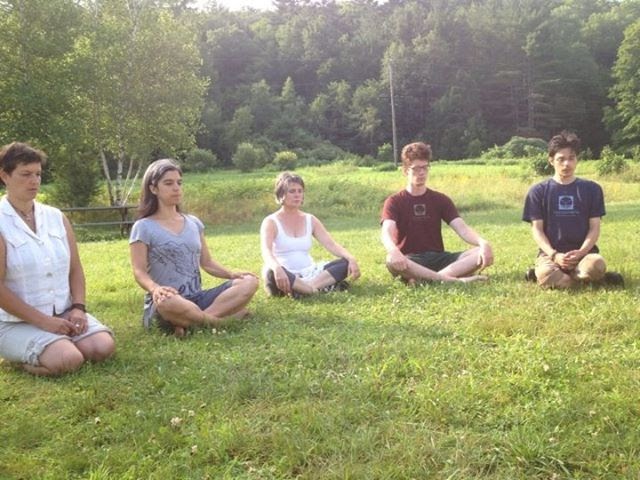
Morning movement classes ended with quiet breathing.
Joel began day 2 by discussing the five types of capital—human, social, ecological, built, and financial—and the relationships among them. After this talk and the one the day before, I wasn't sure if we were ever going to get to discussing how to incorporate regenerative design into our work. That was until Joel began talking of Wendell Berry's essay "Solving for Pattern." This was more in line with what I had hoped to learn about in class. I wanted to understand natural systems thinking and how to design for such.

That brief moment of reflection over Wendell Berry was followed by Joel encouraging us to "look for the difference that makes a difference." Okay. He lost me again. How am I supposed to be able to find "the difference that makes a difference" if I don't actually learn a single thing about regenerative design by the end of this class? I'm embarrassed by my impatience and ignorance now. This all seemed like "fluff" at the time, and I wanted substance. What was it that Joel was teaching me that I wasn't seeing? Why was he telling me all these tales of warriors and writers rather than telling me about how to regenerate systems?

That morning Joel also introduced us to the concept of ecological succession. This was something I learned about briefly in freshman botany. But rather than giving us a textbook definition of ecological succession, he told us about its importance in an ecosystem. According to Joel, this system is successful because of the disturbance it creates. The disturbance “breaks up” the older trees so that new ones can come through, and that disturbance generates a host of other regenerative processes that enhance the soil and feed the species that live on that land.

He then related that concept to us, saying that people need to be disturbed so that newness can come through. In Joel’s words, as humans we habitually live in a two-force world: we have a force that drives us (an activating force) and a force that prevents us from achieving our goals in nearly every case (a restraining force). These forces constantly push up against one another and often result in a compromise, where no one on either side is happy with the end results.

I could apply this to my life as an environmentalist. Environmentalists often witness compromises in which no one is pleased with the final decision. Living in a two-force world, we are used to forfeiting or agreeing to something we don't like in order for the outcome to be "less bad."

Joel proceeded to introduce us to another type of force, a "reconciling force." In natural systems, when a reconciling force is introduced the system finds its balance. In human systems, when that reconciling force is found, everyone walks away from a decision point feeling as though a critical value of theirs has been honored. But in order to find this reconciling force, we first need to fully understand what each side values and work from there.

Finding the value of something that opposes you is just as hard as it sounds. We tend to devalue our restraining forces. We see something in opposition to us as a burden and often overlook its driving force. Why should I care what it values? It limits me! For instance, I could say the only thing coal companies value is financial capital and not look farther that. In this instance, we overlook the other kinds of capital this establishment might value, such as social, built, or maybe even ecological capital. Or maybe every coal company only really does value money—I honestly don't know. But if you do not take the time to observe what a restraining force values, you will never move beyond compromise. I'll come back to this idea later.

Before lunch on Monday, Joel introduced us to the concept of a purpose statement.  He wrote the following purpose statement for our class:
          To develop a coherent way of seeing and working
          in a way that enables evolving awareness and practice
          so that we can be effective and useful in the world.
He then proceeded to say that we would achieve this task by the end of the week. Once again, I was quite confused as to where these words came from and how we were supposed to go about achieving this goal when I didn't even yet understand what regenerative design fully was.

After lunch Joel asked us to pick a task for ourselves and develop a personal purpose statement for that task. He then directed us to split up into teams of two and discuss our tasks. For an hour or so I sat with Shawn, a student I took Constructed Wetlands with. Shawn and I both had chosen big tasks that would improve our respective regions. He wanted to improve the culture of his hometown, and I wanted to revive areas of Appalachia that were plundered by extraction processes. We talked for a long while about our interests, and jotted down a few words for what we believed would be our purpose statements. Easy enough, right? Well, when regrouped, Joel posed more questions for us and we found that our statements needed to be refined. What Shawn and I had chosen weren't really tasks but long-term goals and dreams. How hard was it really to write a purpose statement? And what was the significance of doing so?

The class spent a lot of time outdoors. We had many discussions inside the Yestermorrow treehouse.
Tuesday morning, following our morning exercises, Joel told us we were going to be doing a different kind of exercise. After opening up a discussion on how nature works in patterns, he brought us outside and told us we were going to learn a bit about tracking. I like to think of tracking as really immersing yourself in nature. It involves using each of your senses and slowly taking in your surroundings. It's a very calming activity. I found myself being less distracted and more on point with my thoughts immediately following our tracking experience. Which was ideal because Joel proceeded to question us and add more elements to our tasks at hand.

In order to fully develop a statement of purpose, we were to break down our task a bit more to make it more approachable and therefore more achievable. It had to have a clear process as well as products. Which forced Shawn and I to sit down and really rethink our tasks. I brainstormed a few ideas of tasks I could do in Berea and then went through another round of discussing what I valued in each of them.

At this point, I was beginning to feel a little unsure of myself and this class. I loved the nature exercises, but I could not see how developing a task cycle was useful. This felt like a "personal ecology" class where we had to sit down and analyze our values. I didn't understand why any of this was important until I went to town to get some groceries.

As I was opening the trunk of my car to set my groceries down, my eyes rolled across my GRE prep books. I groaned over their existence, and started to shut the trunk to my car when something Joel said crossed my mind. Joel had introduced us to the idea of disturbances, which are things that often repel us or shake up our way of thinking. I reached back into my trunk and pulled out my books, and immediately began to ponder what was causing this disturbance inside me. Why did I detest studying for the GRE? Why did the sheer thought of it disgust me? I sat there on the trunk of my car for a minute and began thinking about everything Joel had been talking about with us this past week, and that's when my eureka moment hit. Suddenly all his talk about disturbances, systems ecology, and tasks clicked. I proceeded to go to my notebook and began to write down a new task for myself.

The next morning, the class gathered to discuss regenerative design on a wider scale. In order to understand the importance of regenerative design and how to apply it, you have to understand how the system is working. Nature functions in a self-organizing, systematic way. In order to see how nature engages and exchanges information, you must be able to view its patterns. The whole of nature works in patterns of forces working off one another and growing together to form a successful living system. No one part of nature is in dominance, and all disturbances created by its functioning parts lead to the development of the system. There is value found in each part of system, and the other functioning parts recognize this and develop accordingly. It's miraculous, really. The ecological system doesn't make compromises because it’s a system of reconciling forces, and it meets the needs of every organism living in it.

Here in lies the human problem. Our society has set itself apart from the natural world. Our system tries to exist outside the realm of nature, and this is where it often fails. Conventional design makes up most of the system, and it is just one step above the law from being uninhabitable. LEED, or green building, initially started off with a great mission, but has since become a standard that is "less bad" but still not great. And sustainability is just scratching the surface. We are not going to make this Earth habitable if we are all living sustainably. We will just slow down the degradation. This is why we must aim for regenerative design, which calls for us to live as nature, and to co-evolve with the rest of the ecological system. We cannot live in a system that has set a course for degradation. In terms of ecological succession, conventional infrastructure has climaxed; since its initiation, it has slowly begun to fall apart while natural systems continue to grow and thrive just as they always have.

After accepting these realizations, you might ask yourself, "How do I become a part of this natural system?"

We must "find the difference that makes the difference, and act." This requires us to create a task, find the forces that drive and restrain it, discover the values in those forces, and then come up with a reconciling force that makes a difference in that system. It turns out, all the exercises we were doing all along so far in class were actually foundational to the process of regenerative design. We were learning about regenerative design all along, we just didn't understand all of its different processes and parts. I say "we" because all of us taking the course felt quite lost to begin with, but the more we began discovering the values of the tasks we assigned for ourselves, the more we began to see value in ourselves, in the course, and in its purpose statement:
          To develop a coherent way of seeing and working
          in a way that enables evolving awareness and practice
          so that we can be effective and useful in the world.

The final day of the class, Joel had us present our task and own personal statement to the class. I stood up and presented my own task:
          To take the GRE
          in a way that my anxiety does not hinder my perception of my 
               capabilities
          so that I can apply for graduate programs that will allow for a 
               continued education in ecosystem development.

When I pulled my textbooks out of my trunk, I realized the disturbance was mainly caused by my anxiety. I've found over the years that my anxiety issues are my greatest restraint. My anxiety has adverse effects on my test taking, my social interactions, and my overall development. I find that my anxiety attacks often leave me emotionally and physically drained to the point where I am left incapable of completing some of the simplest tasks. And a full college load has not helped lower my anxiety any. As a result of this disturbance I began to not only analyze the value of the GRE, but the value of myself and the system within which I functioned. I realized that my anxiety does limit me, but even it has its values, and if I cannot be a functioning member of the system I wish to be a member of, then I am not performing my ecological niche. The system I chose to be a part of cannot reach its fullest potential without me.

I decided I needed to start somewhere, to choose a small task that was manageable and wouldn't overwhelm me to the point of me being ineffective. So I chose to sign up for and begin studying for the GRE. And in order to successfully accomplish this task, I had to understand that my perceptions of this exam would have an overall effect on how I would perform. I could study for hours on end, but if I didn't believe in the value of my studying and myself, I would not be serving myself to the best of my abilities. I realized that being able to study for the GRE and relearn some of these concepts again is a privilege. It can only help me become a better version of myself.

With this in mind, when it comes time to take the actual test at the end of August, I will be ready to take it no matter what. My perceptions are the difference that makes a difference, and I'm pleased to report that since laying out my task, I have successfully studied for the GRE each and every day. I find myself learning more and more by the day, and I have a completely positive perception of myself and the work I'm doing. It sounds almost too good to be true, but by partaking in the regenerative process, something inside of me was regenerated. Only growth can come from what I took away from this week.

We ended the class with an exercise we had been doing every morning. Joel referred to it as "the snake," and it involved us weaving in and out of one another in a line. The beauty of this exercise is that it fully tied together everything we had learned in regenerative design. Each person used the force coming toward them to propel the other along in the line. We were a line, or a system, of reconciling forces that used the others’ force to push and move forward. Just like in our ecological system, we were moving parts that required the strength of others to grow and develop.

The Snake dance - moving gracefully with opposing forces
In sum, I would say the lessons from this week were some of the most rewarding of my entire stay at Yestermorrow. I dove into something completely different than what I had anticipated and reaped more rewards than I expected. These lessons will stick with me, and now that I have an understanding of the regenerative process, I'll be able to apply it to more aspects of my life. The beauty of this process is that it can apply to just about anything. Every process can be regenerative; thus, the final products can also be regenerative. And we can all afford to learn and grow throughout every step of the process.

*********
Brittany completes her internship at the end of this week. We will miss her good energy and her insightful reflections on her time at Yestermorrow. You can read more posts from Brittany's time at Yestermorrow on her blog.

Saturday, June 15, 2013

Live From the Tiny House Fair: What Do You Want Out Your Composting Toilet?

Abe Noe-Hays of Full-Circle Composting Toilets polls the crowd


Here's what we came up with:
-no odor
-small
-no insects
-easy to clean
-low input/easy to maintain
-sanitary
-discrete
-affordable
-beautiful
-can operate at low temperature
-useful [by]product

What do you want out of your composting toilet?

Live From the Tiny House Fair: Building an Eco-Village


Guest post by tiny house dweller, author, and former Yestermorrow Intern Matt Wolpe.


Starting with 14 acres and a lonely sugar shack, Gwendolyn Hallsmith delicately wove several tiny houses into her broader vision of an eco-village in Cabot, Vermont.  Treading lightly on her land (leaving the majority aside for preservation, which supports seven families) tiny houses are carefully placed throughout to serve as guest houses, studios and temporary housing while families build their permanent housing - which then frees the tiny houses up for adaptive reuse.

Gwendolyn, as a zoning and code savvy visionary, stressed the importance of using a municipal sewer and water system as a responsible way to cluster housing on a smaller portion of a larger plot of land, noting that when you are relying on a septic system, residents need to be spread out further from each other, causing more interruptions of the existing landscape.


More home sites are available at Headwaters if you are interested in joining Gwendolyn and company.  Additional info can be found here: http://headwatersfarm.blogspot.com/

Overheard at The Tiny House Fair: Boats and Lunchtime Musings

For those of you who have devoted hours of your time pouring over design solutions for living in small spaces, you've probably discovered the treasure trove of clever furniture and space uses in the sea-bound world. I caught a couple of snippets of marine inspirations and aspirations at lunch today:

1. A university administrator and recent empty-nester came here this weekend because she's plotting for her next life step: unrooting herself from her long-term home and setting out for an adventure. She dreams of living on a boat, but because of sea-sickness and the maintenance required of water-worthiness, knows she can't do it on the water - so why not on land? Hopefully this weekend will give her some of the tools and inspiration to retrofit a boat-home-on-wheels!

2. Have you heard about the Air Head Composting Toilet? One of PAD's participants favors this system over the many composting toilet options on the market or for making. Originally designed for boaters, this system is small, effective, efficient, and easy-to-maintain. It handles solids and liquids separately, diverting urine for easy disposal (e.g. remove it, dilute it, and water your fruit trees!); the poo-container is lined with coffee filters, which you dump into the aerating basin by "flushing" a lever. Add some carbon-material to the mix (she likes to use CoCo Core - a coconut husk product) and after some time you've got good, water-saving, human-generated compost! Hopefully I'll get to learn more about this at the afternoon's Full-Circle Composting Toilet talk.

Live From the Tiny House Fair: Think Outside the Box

(and building for a whole heck of a lot less while you're at it)

What a way to start the day!

"the cub", a.k.a. smurfmobile

Strolling across the sunny lawn to breakfast this morning, I was excited to see the arrival of "The Cub," a 4'x7' house on wheels that brothers Deek and Dustin Diedricksen of Relaxshacks are cozily calling home for the weekend.

The two started off today's activities with their talk "How to Build Your Own Home for a Heck of a Lot Less - Thinking Outside the Box." Anyone who's morning coffee hadn't quite kicked in yet, was quickly awoken by Deek's charisma and wit as he and Dustin related their experiences with building small-sized treehouses, trailer houses, and "ground-bound dwellings," using largely found, salvaged, and alternatively-purposed materials. In addition to testing the limits of what constitutes a dwelling space, making "cheap" art, and creatively building, the two are dedicated to re-directing the waste stream, getting functional materials out of the landfill and into use.

With over 20 years of "freeform building" under their belts, and Dustin's work as an environmental toxicologist, the two had a wealth of knowledge, experience, tips, and tricks to share. What I was most struck by, however, was the strong sense of freedom to experiment, learn, and push boundaries they'd granted themselves by seeking materials outside of the conventional. With stacks of found and free wood and odd windows, why not see if you could build a home in under 40 sq. ft? Why not create asymmetric window and siding patterns? Or use salad bowls and pickle jars as protruding windows and inset terrariums?

Some of Deek and Dustin's Tricks and Tips for Salvagers, Trash-Pickers, and Tiny-Livers:

- Keep a materials salvage Road Kit in your car, including: tarp, straps and bungees, crowbar, hammer, drill, Leatherman/multi-tool
- Let people know that you're interested in collecting building materials - word gets around!
- Develop a relationship with your local mom'n'pop sawyer and lumberyard
- Surf Craigslist (especially in affluent areas)
- Visit the "Take It or Leave It" section at the transfer station
- Ask for mis-mixed "oops" paint at the Loews or Home Depot
- Project Phasing: with some poly- or weather-protecting finish, it's fine to leave plywood sub-floor or sheathing exposed as your flooring or siding; don't worry about "finishing" it until you come by the money or desire!
- Get creative with typical household items - a glass bowl can become a window, a metal pail could be a sink, a teapot is a perfect planter
- Try It Before You Buy It - airbnb.com is full of tiny houses for rent, so next time you travel, thinking about booking a small space instead of a hotel room
- Space-Savers: Murphy beds, fold-down tables, shelving nooks behind stairs or in protruding windows, stair step seating


Do you have any creative ideas for inexpensive, small-scale living? Share your dreams and designs!

Friday, June 14, 2013

Live From the Tiny House Fair: Building a Community

Two of our featured speakers and their houses: the Ecovative Mushroom Tiny House and the COMET camper have arrived, growing our weekend tiny house community.


Lee Pera and Brian Levy from Boneyard Studios kicked off the event with a talk about how their tiny house showcase on an alley lot has been a vehicle to build community in DC. 


I was excited to hear Lee and Brian talk about how the Boneyard project evolved, from a monthly Meetup group daydream, to a parking lot turned community garden and inhabited space - a place to expand the conversation about small-living and issues around affordable housing. 

As Lee and Brian shared their passions for community outreach and dialogue, a lively energy permeated the group - it was clear that people had been anticipating being in a room with so many like-minded enthusiasts. Questions ranged water and sewage solutions, complicated zoning navigation, and the presenters' aspirations for their own tiny-living; and each response only brought up more questions - it's a good thing we still have two days to continue the conversation!

How do you reach out in your neighborhoods and build community and awareness about housing issues through tiny-house-living?

Live From the Tiny House Fair: ...GO!


The scene is set!

The Yestermorrow campus is held in a ready stillness, our presentation rooms ready for eager listeners, our staff bustling about the grounds, as our first guests start to trickle in.
tent ready for the welcome dinner
the first roving-home to arrive
camping area - all marked out
wood shop yesterday, presentation space tomorrow
yestermorrow chairs ready for the first talk in the main studio: building community 
our executive director and operations manager ready to check-in our attendees

Thursday, June 13, 2013

Live From the Tiny House Fair: Get Ready, Get Set...

The rain clouds have cleared just in time to get the finishing touches on Yestermorrow's campus as we prepare for our Tiny House Fair guests to arrive! We're gearing up for a beautiful and lively weekend with a host of lectures, conversations, and events led by over a dozen small-living notables, not to mention the ample opportunities all attendees will have to engage in conversations about alternative living, community-building, and innovative technologies.

For those of you who aren't able to join us in Waitsfield, we'll be reporting from the event throughout the weekend, so be sure to tune in and join the conversation online!

Tuesday, May 07, 2013

Conference Room Collaboration

This spring, when we looked at our capital improvement projects for the year on the Yestermorrow campus, we decided to focus on one area during our "spring break" week. Unlike the typical spring break (sunny beaches, beer, etc), here at Yestermorrow we close to classes for a week each spring and fall to work on facilities projects—things we can only do when there are no students around. This April we decided to put our energies towards sprucing up the conference room and lobby. And in typical Yestermorrow fashion, it was truly a collaborative project.

The first step in the process started in February with the design of a new conference room table, spearheaded by instructor Ben Cheney. After a visit to the "boneyard" out on the tennis courts, he picked out three thick slabs of maple that we had harvested and milled a few years back in a Stump to Sticker class. He decided to leave the live edge on the two long sides, and after the wood had acclimated in the shop for a few weeks, he glued up the three slabs into a tabletop. Then back in his own metal shop in Montpelier, Ben fabricated steel legs which were then joined to the tabletop, with room for inevitable expansion and shrinking as the wood shifts over the seasons.


The next step was looking at the other furniture in the room and thinking about our options. The Woodworking Certificate students were looking for a project for their veneer week, led by instructor Steve Skonieczny. After working together on the design and a series of mock-ups and models, they decided on a pair of tables, one in the lobby and one in the conference room, that mirror each other with different veneer and wood selection. And they designed a curved brace to support each table, to make it easier to clean underneath. 

With both tables underway, and our break week upon us, it was time to get out all the existing furniture in order to paint the walls and trim and lay down the new floor. We ordered pre-finished birch flooring through Lathrop's mill over the mountain in Bristol, VT (Exclusively Vermont Wood Products). Dave Warren and our intern team installed the flooring in two days along with some new baseboard trim. While the new floor was going in, we brought in professionals to strip and re-finish the hardwood floors in the lobby. By the end of the week we did a deep clean and had furniture back in place and everything ready for students arriving on Friday night.

We also were lucky enough to connect with a new project called Embracing Art. A group of professional artists decided to share some of their artworks with non-profit organizations that are doing good work in their home state of Vermont and beyond its borders. They donate these artworks to shelters, environmental organizations, educational institutions, and many other kinds of non-profits. We were lucky enough to connect with Montpelier artist Maggie Neale, who donated a recent piece of hers entitled "Intersections", a combination of oils and collage. It now hangs as a focal point in the conference room space.

Our next step is to replace the computer station table with a concrete countertop which was just poured the last weekend of April. We're waiting for it to cure, and once it's been sealed we will install it on the east wall. We're also finishing up a few new cork boards for the walls but wanted to share with you the photos of our "new" space, it feels great!

-Kate

Wednesday, April 03, 2013

The Nature of Design

A guest post by Malena Marvin, Yestermorrow instructor

Modern humans are terribly good at transforming raw earth, at a massive scale, into toxic “waste” products that ecosystems cannot re-assimilate. We do this when we make products, develop energy, and when we house ourselves. By all measures, we are doing this too well, and too fast, re-making our planet into one that is less and less conducive to life.
 

photo by Malena Marvin
We need to change how our species makes and creates. But simply exchanging “green” materials for “conventional” ones won’t cut it. What’s required is a revolutionary re-wiring of how we design and build our habitat, derive our energy, and make our things. The mainstream of design needs a new worldview, and quick!

Luckily, the instructions for this “new” design philosophy are intrinsic in our own biology and the ecosystems we live within. The field of biomimicry is rolling out nature’s blueprints, and the concept of biophilia is helping us to see that this is good news for our stressed out, isolated, and medicated modern selves. Indeed ecological designers and permaculturalists are re-envisioning a world in which humans regenerate their own landscapes, creating thriving ecosystems whose biodiversity feeds our souls just as it does our bellies.
 

But we can take ecological design even deeper if we acknowledge that how we learn so often trumps what we learn. Sitting in front of the glowing tsunami of electronic information can introduce our brains to important abstract concepts, but it will not address the fact that in order to design like we are part of nature, we need to authentically experience ourselves as natural. Ecological literacy may be taught in the classroom, but ecological fluency must be earned outdoors, through observation and physical inquiry.
 

Our counter-evolutionary cultural insistence on living physically and emotionally separate from our support (eco)systems has created a dangerous negative feedback loop. We interrupt this loop whenever we spend real time experiencing what is wild and nonhuman. It’s our imperative as designers to consciously translate that experience back into our habitat, so that we can create space that awakens because it is alive.
 

photo by Malena Marvin
The Nature of Design reconnects designers with their animal natures, taking the pedagogy of design beyond its rectangular classrooms, and out into the living, breathing, photosynthesizing world. We track projects and ideas in deep ecological design at natureofdesign.org and our courses research how back country immersion and experiential study of ecology influence creativity and the design/build process. A recent peer-reviewed study bolsters our approach, finding that "…four days of immersion in nature, and the corresponding disconnection from multi-media and technology, increases performance on a creative, problem-solving task by a full 50%.” The Nature of Design is bringing this line of inquiry to the field of design and architecture.

If you like these ideas, or know someone who would, consider taking a field- and nature- based Nature of Design course through Yestermorrow this year. Students will explore biomimicry, biophilia, and other concepts in ecology and ecological design on a multi-day backpacking trip before diving into a culminating design project in the studio. Through hands on activities, readings, and discussion, students will ask: How does immersion in a natural environment impact creativity and design decisions? Can an experiential understanding of natural processes lead to more "natural" design? What would it look and feel like to truly align contemporary building with the principles of ecology?

Saturday, February 09, 2013

Seattle Wanderings

image courtesy www.seattleplace.com
Turns out, everyone says Vermont and Seattle attract the same kinds of people. I'm not sure that's true, but there certainly a lot of Yestermorrow folks in that neck of the woods. I recently returned from an expedition to Seattle, WA. It was fun to catch up with people and hear what they're up to since Yestermorrow. Here are a few of their stories...

Jeremy Culver was an intern at Yestermorrow back in 2002 when he was in architecture school at Ball State University. After graduation he headed west and has been in Seattle ever since, working as a design/builder for a firm called Carlisle Classic Homes, where he's one of the main project managers for their renovation and remodeling clients. In his spare time (along with raising three cute kids) he has spent the last seven years renovating a 700 square foot bungalow in West Seattle. When I got a tour of his home I immediately recognized a number of touches that reminded me of Yestermorrow and the projects Jeremy worked on when he was here- attention to joinery, unusual hardware selections, and a natural wood finishes.

Janie Barnett first arrived at Yestermorrow in 2002 and over the next few years took seven courses. She went on to build the home she designed in the Home Design course in nearby Fayston, VT which features super insulated walls, passive solar orientation, locally sourced lumber, reclaimed materials and beautiful details. Her experience designing and building the house has led her to continue to pursue research in green building and building science, and since she moved to Seattle she's been advising others on how to build homes free of toxic materials and electro magnetic frequencies.

Catherine Calvert is an architect at VIA Architecture where she is Director of Community Sustainability for their Seattle office. She came to Yestermorrow in 2010 to take our Farm Design course as a way to further her interest in design connected to food production and urban agriculture. It was exciting to hear about some of the pro bono community projects her firm has worked on to support urban gardens in the local area among other projects.

Sam Kraft and Ji Shon were both Yestermorrow interns (2006 and 2004, respectively) who both ended up studying architecture at the University of Washington. Sam just graduated and Ji is finishing up her M.Arch this semester. Sam has continued to build a variety of projects while he was in school through Abacus Fine Carpentry and is in the process of forming a design firm which hopes to combine technology with an eye towards nature, and also incorporating Permaculture design.

Kristin Engelbrecht Bleem was an intern in 2006 and since settling in Seattle owns her own painting firm, Eager Beaver Works. She tackles all kinds of projects from historic home renovations to new construction, and provides handywoman services. And every once in a while when she gets bored she leads groups of college students on exchange programs in India to study Buddhism. A multi-talented lady.

I also got to see (briefly) two recent intern graduates, Chris Landingin (now an apprentice carpenter for a small design build crew) and Jess Osserman (on the job hunt) as well as former intern Scott Szeman (who admitted he had not touched a hammer since his internship in 2008 and has gone back to investment banking).

While at the University of Washington I did a presentation about Yestermorrow and visited with Steve Badanes (longtime YM instructor) and Kimo Griggs (former instructor) who both teach in the architecture program there. And had a shop tour with YM woodworking instructor, Steve Skonieczny, who runs his own cabinetry and furniture business out of Ballard Woodworks, a woodworking school and professional cooperative located near downtown Seattle. He is one of five professionals who work out of the shop full time and occasionally teach classes.

It was a whirlwind trip, but great to re-connect with so many Yestermorrow friends and hear how their time at Yestermorrow has influenced their careers and lives.

-Kate

Friday, January 04, 2013

Solar numbers are in!

With the start of the new year, it's a good time to look back at 2012 and where we've been. I took the opportunity to check out our 2012 solar production numbers compared to the past few years (our 28kW array of AllSun Trackers was installed in April 2010). We produced 38,283 kWh in 2012, up from 35,255 kWh in 2011. This equals 75% of the annual electric load for our main campus building.


Tuesday, October 23, 2012

Design by Nature

I just got back from an inspiring weekend at the Omega Institute's Design by Nature conference. As someone who goes to lots of conferences every year, this one was a breath of fresh air. More inspirational than technical, the focus of the weekend was about how we can connect with, and learn from, the environment around us. 

The gathering brought together some of the major thinkers in the field of whole systems thinking – Janine Benyus, Van Jones, Jeremy Rifkin, Bob Berkebile, Dickson Despommier, and Natalie Jeremijenko. It was exciting to think about how our work at Yestermorrow connects with these broader themes of designing with nature, biomimicry, living buildings, creating a new green economy, new ways to produce food in cities, green job training, community-based design, and social activism through art.

I attended with Jeff Schoellkopf, one of our longtime faculty and board members, and his son (and YM alum) Carson Schoellkopf, who recently graduated from college. It was great seeing so many college age students in the audience at Omega being excited about these topics. We ended up talking a lot about inter-generational dialogue and how a movement for change needs to come from all different sectors of society.

Constructed wetlands in front of the OCSL
We also had the opportunity to tour the Omega Center for Sustainable Living (OCSL) which was one of the first buildings to meet the Living Building Challenge. The building treats all of the waste water from the Omega campus through a series of constructed wetlands and an Eco Machine. The building produces all its own energy, recycles all its own water (and more!), and is built with reclaimed and nontoxic materials.

It was interesting to think about how Omega's experience working with campus wastewater might influence our master planning for the Yestermorrow campus. We're hoping to be able to demonstrate some of the same cutting-edge alternative water treatment systems, although on a smaller and more residential scale that can be phased as we build out the campus.

Many thanks to Omega for inviting a group of Yestermorrow folks to attend and we look forward to more connections in the future.

-Kate

Wednesday, September 19, 2012

What is a Ladderback Chair? How is it made?


Start with a green (freshly cut) log.  
Split it with a mallet and a froe.


Shape the legs and rungs with drawknives and spoke shaves, while sitting astride a shave horse.


Create beautiful wood shavings (great for kindling).


 Assemble the components (and celebrate!).


Shape and steambend the ladderback slats, add cloth tape to the seat, and voila!


Look like fun?  Join us for the next offering of Green Ladderback Chairs: October 7-13.  Mention this blog post and we'll give you $100 off!   Call Mark at 888-496-5541 for more info or to register.

(* Thanks to our model, Jeff Labanara)


Thursday, August 30, 2012

Student Impact: Shipping Container Finds New Use at ECO City Farms

A young entrepreneur, farmer, and environmental educator, Adam Schwartz came to Yestermorrow seeking hands-on learning in design/build with a strong focus on sustainability. Interested in working at the intersections of ecological design, green building, and sustainable agriculture, Adam chose Yestermorrow’s Certificate in Sustainable Building and Design as the path to pursue his vision for contributing to the growing vibrant food economy.

Adam is farm manager at ECO City Farms, a 1.5 acre educational urban farm in the Capital Beltway in Maryland. For his Sustainable Building and Design practicum project, Adam is putting a sea shipping container to new use by designing and building the FoodShed, an on-farm commercial kitchen for value-added production and a teaching kitchen for local food production.

The project demonstrates low-cost solutions for food processing and enables value-added and farm-to-school food entrepreneurial ventures. The licensed and certified kitchen, constructed of predominently reused materials, features a solar hot water system and an integrated greywater filtration system. The FoodShed will host a variety of cooking and food preservation classes throughout the year. Funded by the Southern Maryland Agricultural Commission, the FoodShed is being documented closely so the open-source design can be shared with other small farmers.

Wednesday, August 15, 2012

Students Go the Distance for Community Design/Build

Architecture students, engineers, and builders have traveled from across the country and—in the case of one student—from the Black Sea to design and build a full-scale public project at Yestermorrow. Led by the dynamic team of Jersey Devil co-founders Steve Badanes and Jim Adamson, along with New York-based architect Bill Bialosky, this year’s Community Design/Build Class is working on a composting toilet structure for Shelburne Farms, a nonprofit education organization, 1400 acre working farm, and National Historic Landmark.

Students from the Eastern Seaboard and beyond have come to Yestermorrow for hands-on experience in working collectively as a team and with the client to establish the program, work within a budget, propose and develop the design, schedule the work, and construct the building. Each phase is explored as a means of making the architecture more expressive, and sustainable building practices are emphasized throughout the process.

New Orleans is represented in this student group, as is Washington state and Northampton, Mass. Intern Peter Stewart from New South Wales, Australia brings his experience in functional art and building to the class. 

Civil engineer Ryan Galliford rode his bike the 2000 miles from Pensacola, Florida to Yestermorrow to take part in this class. Ryan studied building science in college; he worked toward licensure in civil engineering after graduation and currently works for a small engineering firm that encouraged him to take this class. Becoming interested in design/build, Ryan researched Jersey Devil projects and then realized he could work with the renowned team right here. From Ryan’s perspective, the Jersey Devil team is rejuvenating the medieval craft of architecture, where the designers are the builders and the built form expresses personality and values. The Community Design/Build class resonates with Ryan's desire to put his energies to productive use in the world and is a great way to learn from masters and get his hands into the design/build process while having a great time.

Ayse Sahin and Ryan Galliford
Architecture student Ayse Sahin, a master's degree candidate at Istanbul Technical University, traveled from her native Turkey to be part of this year’s Community Design/Build class. Ayse is preparing to write her master's thesis on engaging building arts in architecture curricula. She heard instructor Steve Badanes lecture in Turkey and decided then and there to try to get to Yestermorrow for this summer’s class. Ayse received scholarship awards from Yestermorrow and from a Turkish organization supporting research for master's students abroad. She reports having a great experience in the class so far, and appreciates that Warren reminds her of her home village in the Black Sea city of Giresun.

Friday, August 10, 2012

Yurt for Sale!


We're looking for a client to purchase a yurt built in our September Yurt Design/Build course. The 12’ diameter structure includes a wooden frame, mildew-resistant canvas walls, waterproof vinyl-coated polyester roof, and a domed plexiglass skylight. Easily transportable, the structure collapses down small enough to fit in the bed of a pickup truck.
Yurt with protective wrap still on skylight.
Yurt interior.
Interior joint detail.

Clients pay for materials plus 20% overhead, for an overall total of approximately $1,600. To see more images of yurts built with the same plans in previous courses, visit our photo album for the course.

We’re also looking for clients to purchase yurts built in next year’s Yurt Design/Build workshops. For more information, contact Abby Martin at outreach@yestermorrow.org.