Guest post by Brittany Schroeder,
Berea College summer intern
I've been brainstorming
all week about how I wanted to write this particular blog. It would be easy to
just write a day-to-day summary with a few reflections on my latest class—Regenerative Development & Design—but I do not believe that would do this particular
class justice.
A few weeks ago when I
told Dan, the Curriculum Director, that I wanted to take this class, I honestly
had no idea what I was getting myself into. I thought it would be great to get some
kind of design course under my belt, and the word regenerative intrigued me. Since I have an interest in ecological
restoration work, and regenerative is synonymous with restoration, I thought
this course would greatly assist me in this manner. I was right. It did. But
this course did so much more for me than show me the value in nature. It helped
me see the value of myself in nature.
I know this all sounds
ridiculous. I spent a week in a classroom and I come out talking like I have
found the deepest meaning in life or something. But that is the nature of this course.
I did not just learn about regenerative design; I partook in the process of
regenerative design and, in turn, something inside me was regenerated. Writing this
last sentence, I think it sounds like a post by someone who has completely lost
her mind. Fret not—I haven't completely lost my mind. That will come later, and
it will be a good thing. But I’m getting too far ahead of myself.
To make this easier on
everyone, I'll backtrack to just after dinner on Sunday night, when our class
met for the first time. Joel Glanzberg introduced himself to the class as the
instructor and member of a design group called Regenesis. Rather than have us go around the table and
introduce ourselves, as I’m used to at the start of class, Joel first asked us to
turn to the person next to us and talk about what really mattered to us.
Wait, I was supposed to
have a personal conversation with the stranger next to me and tell them what I
valued most? Well, okay . . . I guess I can do that.
Joel then asked us to
define regenerative, design, and development. I can honestly say that at this point I was feeling
uneasy about what I had gotten myself into. Why was this guy asking questions
of us rather than introducing us to some PowerPoint on regenerative design? I
didn't understand. And I wouldn't understand until about three days later, but
be patient. I'll get there.
We were to meet every
morning at 7:30 AM for morning exercises. These exercises were a combination of
yoga, tai chi, and other meditation exercises. I had taken a class in tai chi last
fall, so I thought it wouldn't be much different. I was of course wrong. These
exercises felt more like stretches than the tai chi I was used to, and many of
them involved movements I was unfamiliar with. Every morning I heard different
parts of my body crack and creak as I stretched in ways that up until last week
I did not think I was capable of. Yet it was strangely relaxing to me. Joel
taught us about proper breathing and movement, and after an hour of twisting and
breathing I found myself not needing my usual morning cup of coffee.
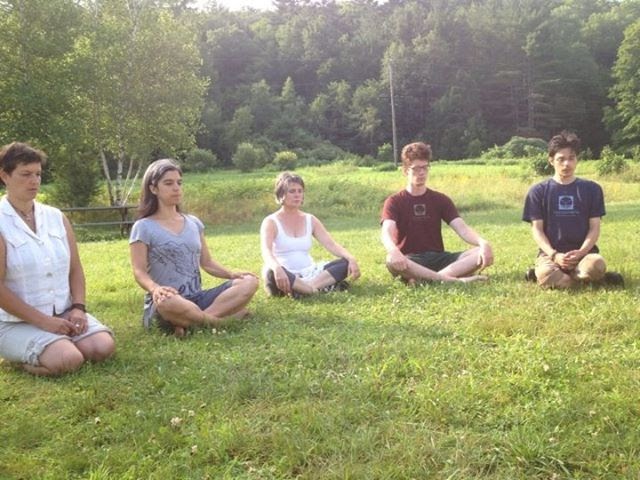 |
| Morning movement classes ended with quiet breathing. |
Joel began day 2 by
discussing the five types of capital—human, social, ecological, built, and
financial—and the relationships among them. After this talk and the one the day
before, I wasn't sure if we were ever going to get to discussing how to
incorporate regenerative design into our work. That was until Joel began
talking of Wendell Berry's essay "Solving for Pattern." This was more
in line with what I had hoped to learn about in class. I wanted to understand
natural systems thinking and how to design for such.
That brief moment of
reflection over Wendell Berry was followed by Joel encouraging us to "look
for the difference that makes a difference." Okay. He lost me again. How
am I supposed to be able to find "the difference that makes a difference"
if I don't actually learn a single thing about regenerative design by the end
of this class? I'm embarrassed by my impatience and ignorance now. This all
seemed like "fluff" at the time, and I wanted substance. What was it
that Joel was teaching me that I wasn't seeing? Why was he telling me all these
tales of warriors and writers rather than telling me about how to regenerate
systems?
That morning Joel also
introduced us to the concept of ecological succession. This was something I
learned about briefly in freshman botany. But rather than giving us a textbook
definition of ecological succession, he told us about its importance in an
ecosystem. According to Joel, this system is successful because of the disturbance
it creates. The disturbance “breaks up” the older trees so that new ones can
come through, and that disturbance generates a host of other regenerative
processes that enhance the soil and feed the species that live on that land.
He then related that
concept to us, saying that people need to be disturbed so that newness can come
through. In Joel’s words, as humans we habitually live in a two-force world: we
have a force that drives us (an activating force) and a force that prevents us
from achieving our goals in nearly every case (a restraining force). These
forces constantly push up against one another and often result in a compromise,
where no one on either side is happy with the end results.
I could apply this to my
life as an environmentalist. Environmentalists often witness compromises in
which no one is pleased with the final decision. Living in a two-force world,
we are used to forfeiting or agreeing to something we don't like in order for
the outcome to be "less bad."
Joel proceeded to
introduce us to another type of force, a "reconciling force." In
natural systems, when a reconciling force is introduced the system finds its
balance. In human systems, when that reconciling force is found, everyone walks
away from a decision point feeling
as though a critical value of theirs has been honored. But in order to find
this reconciling force, we first need to fully understand what each side values
and work from there.
Finding the value of
something that opposes you is just as hard as it sounds. We tend to devalue our
restraining forces. We see something in opposition to us as a burden and often
overlook its driving force. Why should I care what it values? It limits me! For
instance, I could say the only thing coal companies value is financial capital
and not look farther that. In this instance, we overlook the other kinds of
capital this establishment might value, such as social, built, or maybe even
ecological capital. Or maybe every coal company only really does value money—I
honestly don't know. But if you do not take the time to observe what a
restraining force values, you will never move beyond compromise. I'll come back
to this idea later.
Before lunch on Monday,
Joel introduced us to the concept of a purpose statement. He wrote the following purpose statement for our
class:
To develop a coherent
way of seeing and working
in a way that enables
evolving awareness and practice
so that we can be
effective and useful in the world.
He then proceeded to say
that we would achieve this task by the end of the week. Once again, I was quite
confused as to where these words came from and how we were supposed to go about
achieving this goal when I didn't even yet understand what regenerative design
fully was.
After lunch Joel asked
us to pick a task for ourselves and develop a personal purpose statement for
that task. He then directed us to split up into teams of two and discuss our
tasks. For an hour or so I sat with Shawn, a student I took Constructed
Wetlands with. Shawn and I both had chosen big tasks that would improve our
respective regions. He wanted to improve the culture of his hometown, and I
wanted to revive areas of Appalachia that were plundered by extraction
processes. We talked for a long while about our interests, and jotted down a
few words for what we believed would be our purpose statements. Easy enough,
right? Well, when regrouped, Joel posed more questions for us and we found that
our statements needed to be refined. What Shawn and I had chosen weren't really
tasks but long-term goals and dreams. How hard was it really to write a purpose
statement? And what was the significance of doing so?
 |
| The class spent a lot of time outdoors. We had many discussions inside the Yestermorrow treehouse. |
Tuesday morning,
following our morning exercises, Joel told us we were going to be doing a
different kind of exercise. After opening up a discussion on how nature works
in patterns, he brought us outside and told us we were going to learn a bit
about tracking. I like to think of tracking as really immersing yourself in
nature. It involves using each of your senses and slowly taking in your
surroundings. It's a very calming activity. I found myself being less
distracted and more on point with my thoughts immediately following our
tracking experience. Which was ideal because Joel proceeded to question us and
add more elements to our tasks at hand.
In order to fully
develop a statement of purpose, we were to break down our task a bit more to
make it more approachable and therefore more achievable. It had to have a clear
process as well as products. Which forced Shawn and I to sit down and really
rethink our tasks. I brainstormed a few ideas of tasks I could do in Berea and
then went through another round of discussing what I valued in each of them.
At this point, I was
beginning to feel a little unsure of myself and this class. I loved the nature
exercises, but I could not see how developing a task cycle was useful. This
felt like a "personal ecology" class where we had to sit down and
analyze our values. I didn't understand why any of this was important until I
went to town to get some groceries.
As I was opening the
trunk of my car to set my groceries down, my eyes rolled across my GRE prep
books. I groaned over their existence, and started to shut the trunk to my car
when something Joel said crossed my mind. Joel had introduced us to the idea of
disturbances, which are things that often repel us or shake up our way of
thinking. I reached back into my trunk and pulled out my books, and immediately
began to ponder what was causing this disturbance inside me. Why did I detest
studying for the GRE? Why did the sheer thought of it disgust me? I sat there on
the trunk of my car for a minute and began thinking about everything Joel had
been talking about with us this past week, and that's when my eureka moment
hit. Suddenly all his talk about disturbances, systems ecology, and tasks
clicked. I proceeded to go to my notebook and began to write down a new task
for myself.
The next morning, the
class gathered to discuss regenerative design on a wider scale. In order to
understand the importance of regenerative design and how to apply it, you have
to understand how the system is working. Nature functions in a self-organizing,
systematic way. In order to see how nature engages and exchanges information,
you must be able to view its patterns. The whole of nature works in patterns of
forces working off one another and growing together to form a successful living
system. No one part of nature is in dominance, and all disturbances created by
its functioning parts lead to the development of the system. There is value
found in each part of system, and the other functioning parts recognize this
and develop accordingly. It's miraculous, really. The ecological system doesn't
make compromises because it’s a system of reconciling forces, and it meets the
needs of every organism living in it.
Here in lies the human
problem. Our society has set itself apart from the natural world. Our system
tries to exist outside the realm of nature, and this is where it often fails.
Conventional design makes up most of the system, and it is just one step above
the law from being uninhabitable. LEED, or green building, initially started
off with a great mission, but has since become a standard that is "less
bad" but still not great. And sustainability is just scratching the
surface. We are not going to make this Earth habitable if we are all living sustainably.
We will just slow down the degradation. This is why we must aim for
regenerative design, which calls for us to live as nature, and to co-evolve
with the rest of the ecological system. We cannot live in a system that has set
a course for degradation. In terms of ecological succession, conventional
infrastructure has climaxed; since its initiation, it has slowly begun to fall
apart while natural systems continue to grow and thrive just as they always
have.
After accepting these
realizations, you might ask yourself, "How do I become a part of this
natural system?"
We must "find the
difference that makes the difference, and act." This requires us to create
a task, find the forces that drive and restrain it, discover the values in
those forces, and then come up with a reconciling force that makes a difference
in that system. It turns out, all the exercises we were doing all along so far
in class were actually foundational to the process of regenerative design. We
were learning about regenerative design all along, we just didn't understand
all of its different processes and parts. I say "we" because all of
us taking the course felt quite lost to begin with, but the more we began
discovering the values of the tasks we assigned for ourselves, the more we
began to see value in ourselves, in the course, and in its purpose statement:
To develop a coherent
way of seeing and working
in a way that enables
evolving awareness and practice
so that we can be
effective and useful in the world.
The final day of the class,
Joel had us present our task and own personal statement to the class. I stood
up and presented my own task:
To take the GRE
in a way that my anxiety
does not hinder my perception of my
capabilities
so that I can apply for
graduate programs that will allow for a
continued education in ecosystem
development.
When I pulled my
textbooks out of my trunk, I realized the disturbance was mainly caused by my
anxiety. I've found over the years that my anxiety issues are my greatest
restraint. My anxiety has adverse effects on my test taking, my social interactions,
and my overall development. I find that my anxiety attacks often leave me
emotionally and physically drained to the point where I am left incapable of
completing some of the simplest tasks. And a full college load has not helped
lower my anxiety any. As a result of this disturbance I began to not only
analyze the value of the GRE, but the value of myself and the system within
which I functioned. I realized that my anxiety does limit me, but even it has
its values, and if I cannot be a functioning member of the system I wish to be
a member of, then I am not performing my ecological niche. The system I chose
to be a part of cannot reach its fullest potential without me.
I decided I needed to
start somewhere, to choose a small task that was manageable and wouldn't
overwhelm me to the point of me being ineffective. So I chose to sign up for
and begin studying for the GRE. And in order to successfully accomplish this
task, I had to understand that my perceptions of this exam would have an overall
effect on how I would perform. I could study for hours on end, but if I didn't
believe in the value of my studying and myself, I would not be serving myself
to the best of my abilities. I realized that being able to study for the GRE
and relearn some of these concepts again is a privilege. It can only help me
become a better version of myself.
With this in mind, when
it comes time to take the actual test at the end of August, I will be ready to
take it no matter what. My perceptions are the difference that makes a
difference, and I'm pleased to report that since laying out my task, I have
successfully studied for the GRE each and every day. I find myself learning
more and more by the day, and I have a completely positive perception of myself
and the work I'm doing. It sounds almost too good to be true, but by partaking
in the regenerative process, something inside of me was regenerated. Only
growth can come from what I took away from this week.
We ended the class with
an exercise we had been doing every morning. Joel referred to it as "the
snake," and it involved us weaving in and out of one another in a line.
The beauty of this exercise is that it fully tied together everything we had
learned in regenerative design. Each person used the force coming toward them
to propel the other along in the line. We were a line, or a system, of
reconciling forces that used the others’ force to push and move forward. Just
like in our ecological system, we were moving parts that required the strength
of others to grow and develop.
 |
| The Snake dance - moving gracefully with opposing forces |
In sum, I would say the
lessons from this week were some of the most rewarding of my entire stay at
Yestermorrow. I dove into something completely different than what I had
anticipated and reaped more rewards than I expected. These lessons will stick
with me, and now that I have an understanding of the regenerative process, I'll
be able to apply it to more aspects of my life. The beauty of this process is
that it can apply to just about anything. Every process can be regenerative;
thus, the final products can also be regenerative. And we can all afford to
learn and grow throughout every step of the process.
*********
Brittany completes her internship at the end of this week. We will miss her good energy and her insightful reflections on her time at Yestermorrow. You can read more posts from Brittany's time at Yestermorrow on her blog.


 Posts
Posts

