Yestermorrow Design/Build School in Waitsfield, Vermont offers over 80 hands-on courses per year in design, construction, woodworking, and architectural craft and offers a variety of courses concentrating in sustainable design. Now in its 35th year, Yestermorrow is one of the only design/build schools in the country, teaching both design and construction skills. Our hands-on 1-day to 3-week workshops, certificate programs and semester programs are taught by top architects, builders, and craftspeople from across the country. For people of all ages and experience levels, from novice to professional.
Showing posts with label Woodworking Certificate. Show all posts

Tuesday, May 20, 2014

Processing the Process: A Woodworking Certificate Recap Through the Eyes of Ben Murphy

Back on campus for an early-May Timber Framing class, recent Woodworking Certificate graduate Ben Murphy has had some time to let the WWC experience soak in. With a few weeks distance from the program’s finale, he is finally ready to process what the 11-weeks meant to him.

His freshest memories and emotions emanate from the final week of the program, a mad scramble to pull together his projects in time for the final day’s presentations and graduation. “I was a little out of it for the final show,” he says. “I didn’t sleep that much during that week, especially the night before when I was working hard on my cabinet. I had an old shirt on with blood and stains on it.  Right before the presentations, I washed my hair in the sink, then changed quickly into a collared shirt. So I cleaned up pretty quickly right before the show.”

But upon entering the Main Studio, magically transformed into a furniture gallery featuring the impressive creations of the eight graduating students, the exhaustion quickly turned to exhilaration. “It was amazing to see what everyone put together in the final days,” Ben said. “It was cool to see what everyone came up with and how different all the projects were.”

Those projects included chairs, coffee tables, Krenov-inspired cabinetry, stools, a roll-top captain’s desks, hand-carved spoons, and even a harmonigraph, a simple machine powered by weights that, with one push, creates increasingly complex geometric pen drawings that are consistently stunning to the eye.

Much of that creative energy, and the necessary skills to support it, stemmed from the program’s instructors. “I really liked the structure and balance between instructors. We had one instructor, Justin Kramer, who was great, for the entire three months, and then we had professionals rotate in every week. It was very useful. We got to see a bunch of different perspectives and a lot of ways of doing things, and the professional perspective was really useful for me.” Ben also feels that the school’s roots enhanced the program. “The design/build emphasis at Yestermorrow is something you don’t see in a lot of programs.”

The result is a new-found confidence. “I now feel comfortable walking into any shop, mocking up a design and pretty much making whatever I want, so the program was comprehensive and long enough for that. It helps you figure out if you would want to continue with this and, also, what direction you want to go. I now know that I definitely do not want to stop [working with wood]. The curriculum was diverse and touched on so many different things. Now I’m doing a timber framing class. Because I took the woodworking program, I am getting so much more out of timber framing. It’s all joinery, mortise and tenons, and pegs, but it’s just on a massive scale.”

Before turning back to the timber in front of him, Ben adds a final thought about his Yestermorrow experience. “Yestermorrow is a community. It’s great. I met a lot of people that I will be friends with for a while. Everyone is passionate here. The instructors are all really passionate about what they are doing. They’re excited, and the students are always excited,” he says. “It’s really nice to be in that environment.”


-- By Nick Tuff

Thursday, April 12, 2012

Connecting to the Designer Within: An Architect’s Immersion into Woodworking

by Anna Lucey, Woodworking Certificate student
Upon waking my first thought is: maybe I can use the planer to taper that wide board! The strangeness of waking with this thought is compounded by the fact that 11 weeks ago I didn’t even know what a planer was. The reality is this: the Yestermorrow Woodworking Certificate Program is a full-immersion course where you eat, breathe, and sleep the art and science of woodworking. As such, there comes a point where your subconscious takes over the sometimes daunting (but, in woodworking, ever-present) task of problem solving.

At work on a small-scale design/build project.
I came to Yestermorrow with a bachelors degree in architecture and four years of entry-level architecture work (a.k.a. “CAD monkeying”) behind me. The Woodworking Certificate Program caught my eye at a time when I felt disconnected from the designer within. I had spent so much time behind a computer screen fine tuning construction documents that I began losing perspective on what it was I actually enjoyed about architecture: problem solving and making things that were simultaneously useful and beautiful. Certainly woodworking, I told myself, must combine aspects of those things. 

And believe me, as someone who dreamt I was a log after our Stump to Sticker section, it does. 

But it goes so beyond that. I’ve been completely blown away by what I’ve learned versus what I expected this course to be like. What I’ve come to realize as our 11-week program comes to an end is that woodworking is special because:

  1. You get to work with wood and, by extension, forests, trees, lumber mills, micro- (and macro) loggers, lumber yards, and in wood shops with other woodworkers.  
  2. You get to design and build! This process is truly precious to designers because of the conversation between materials and concept. I’ve been blown away at how “design opportunities” (read: “Oh sh*t I just cut this board too short!”), while initially frustrating, can lead to such a rich and sometimes unexpected end product. It’s truly exciting.  
  3. A direct cousin of 2, you get to use your hands all day long. The peacefulness of using a chisel or a hand plane is pretty much unparalleled. Even though you may casually drink 5 cups of coffee throughout the day, you’ll still fall into bed exhausted at the end of it.  
  4. It may have been Rem Koolhaas who said something along the lines of: “Architecture happens in elephant time while all those outside of architecture expect it to happen in rabbit time.” Yeah, yeah, Rem. We get it. But the beauty of woodworking is that is can and often does happen in rabbit time. This does wonders for the psychological well-being of those involved (read: It won’t take you three years to produce something that is so watered down by value engineering that it barely resembles the original beauty of the object you designed).  
  5. You get to smell the difference between walnut and butternut when ripped on the table saw, and in that moment you’ll realize: I love this. 
Hand carving on a shave horse
As with all 20-somethings, I was certain I would know exactly how this adventure in Vermont would go: I would work with my hands, learn a thing or two about wood, and head right back into an architecture office armed with this special new knowledge. But here I am at the end of a truly life-changing 11 weeks. And in this moment, I now realize that it is not the practice of woodworking that will make me a better architect. It is my practice of architecture that will make me a better woodworker. 

And by the way, the planer trick worked great.

Thursday, February 16, 2012

Moving from Woodlot to Woodshop

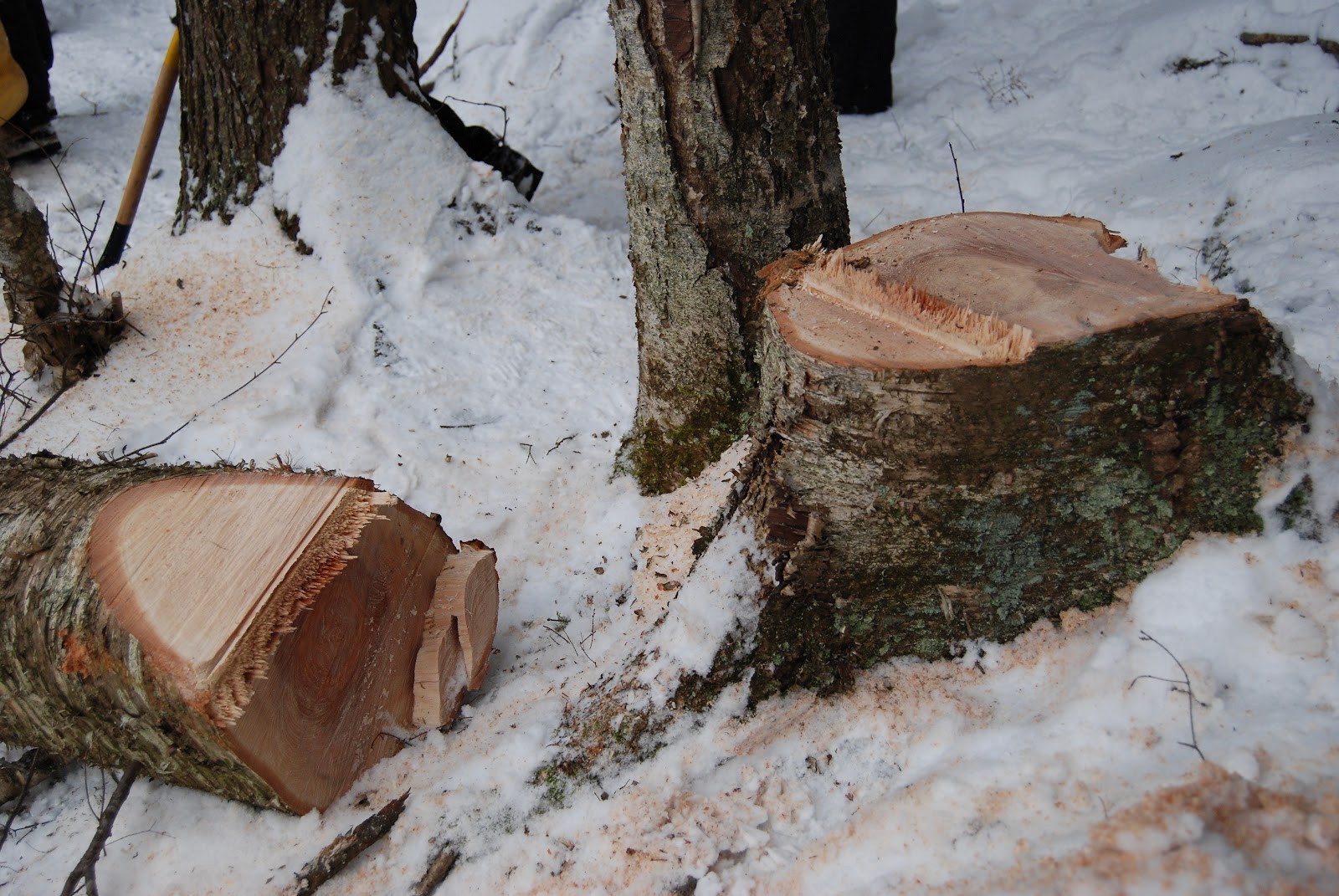
As the 2012 Woodworking Certificate Program enters its third week, students are honing in from forests to fine woodworking. The 11-week intensive course began with sawyer Nick Zandstra, who took students out into the woods on Yestermorrow's campus to analyze trees and the wood they produce, and eventually demonstrate felling and small-scale milling practices.


The class prepares to haul freshly-cut yellow birch logs back to the center of campus.

And those same yellow birch logs, after a pass through Nick's Wood Mizer mill.
From here, students move into the woodshop to learn the tactile essence of this green wood by shaping it into ladderback chairs.
Green wood being shaped into the leg of a ladderback chair.
And from there, they'll move on to cabinetry and boxmaking and other fine woodworking sections of the Woodworking Certificate--always sensing the journey their materials have made from forest to furniture. This deeply interdisciplinary learning environment, where students learn to connect broad forest ecology with detailed boxmaking, constitutes Yestermorrow's core.